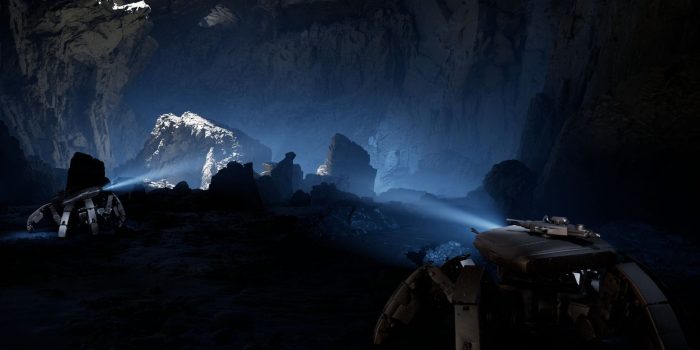
Build a Photoreal Cave Environment for VFX – Part 1
Photoreal environment creation is central to modern VFX, from expansive sci-fi worlds in Dune and Star Wars to the immersive landscapes of Avatar. In this course, you’ll learn to build a cinematic cave environment from the ground up, using real-world reference to guide every stage of production. Designed for intermediate artists, this course covers the full environment pipeline, from reference and layout to lighting, atmospherics, and render outputs for compositing. The focus is on practical, production-ready techniques used by Environment Generalists in film and virtual production.
From Reference to Final Render
You’ll begin by analysing real-world cave references and translating them into a clear visual direction for your scene. The course then progresses to layout and composition, where you’ll establish scale, depth, and camera relationships while avoiding common pitfalls such as visible repetition. Material development focuses on natural rock surfaces, including workflows for wet and dry looks and the use of triplanar projection to handle complex geometry efficiently. Lighting builds on this foundation, introducing volumetric effects, controlled light sources, and cinematic techniques such as god rays to shape the environment’s mood. To support downstream workflows, you’ll set up a comprehensive AOV pipeline, including cryptomattes and light groups, ensuring your renders are fully usable in comp.
Working with Solaris and USD
The second half of the course introduces Houdini’s Solaris and USD workflows, now standard in large-scale VFX production. You’ll learn to manage complex scenes using proxy and high-resolution geometry, assemble environments efficiently, and work with Karma rendering. Asset layout is refined within Solaris using scatter systems and terrain-driven workflows before moving on to advanced lighting. The final stage recreates a cinematic lighting setup that matches your reference, combining skylight, volumetrics, and practical light sources to achieve strong contrast and visual clarity.
About the Instructor
Liam Whitehouse is a Senior VFX Artist with experience at Industrial Light & Magic, Weta FX, and DNEG, working across feature film projects and high-end virtual production. He has also worked in Unreal Engine at NANT Studios in Melbourne, home to one of the world’s largest LED volume stages. Specialising in photoreal environments, Liam brings a production-focused approach to modelling, materials, and lighting, skills directly applicable to both traditional VFX pipelines and real-time workflows.
Course Details
- Course: HOU244
- Level: Intermediate
- Duration: 6h 16m
- Software: Maya, Houdini (Solaris/USD), Unreal Engine
- Instructor: Liam Whitehouse
- Available as part of an fxphd Membership
- Part 2 due for release in May 2026