VFX Cave Environment - Part 1
Taught by Liam Whitehouse
- Duration:
- 6 hours 16 minutes
- Software Version:
- 21
- Launch Date:
- April 2026
- Course Number:
- HOU244
3D
vfx
3D
vfx
Liam Whitehouse is a Senior VFX Artist who previously worked at ILM, Weta FX and DNEG on feature film projects as well as in Unreal Engine at the world's largest LED Wall at NANT Studios in Melbourne. He is a specialist in Photoreal Environments, modeling, materials and lighting for feature films.
This course is ideal for Environment Generalist artists who want to learn how to use Maya, Houdini, and Unreal Engine to create photorealistic environments for VFX shots and Virtual Production LED wall backgrounds.
Class Listing
Class 1: Reference Analysis & Environment Design
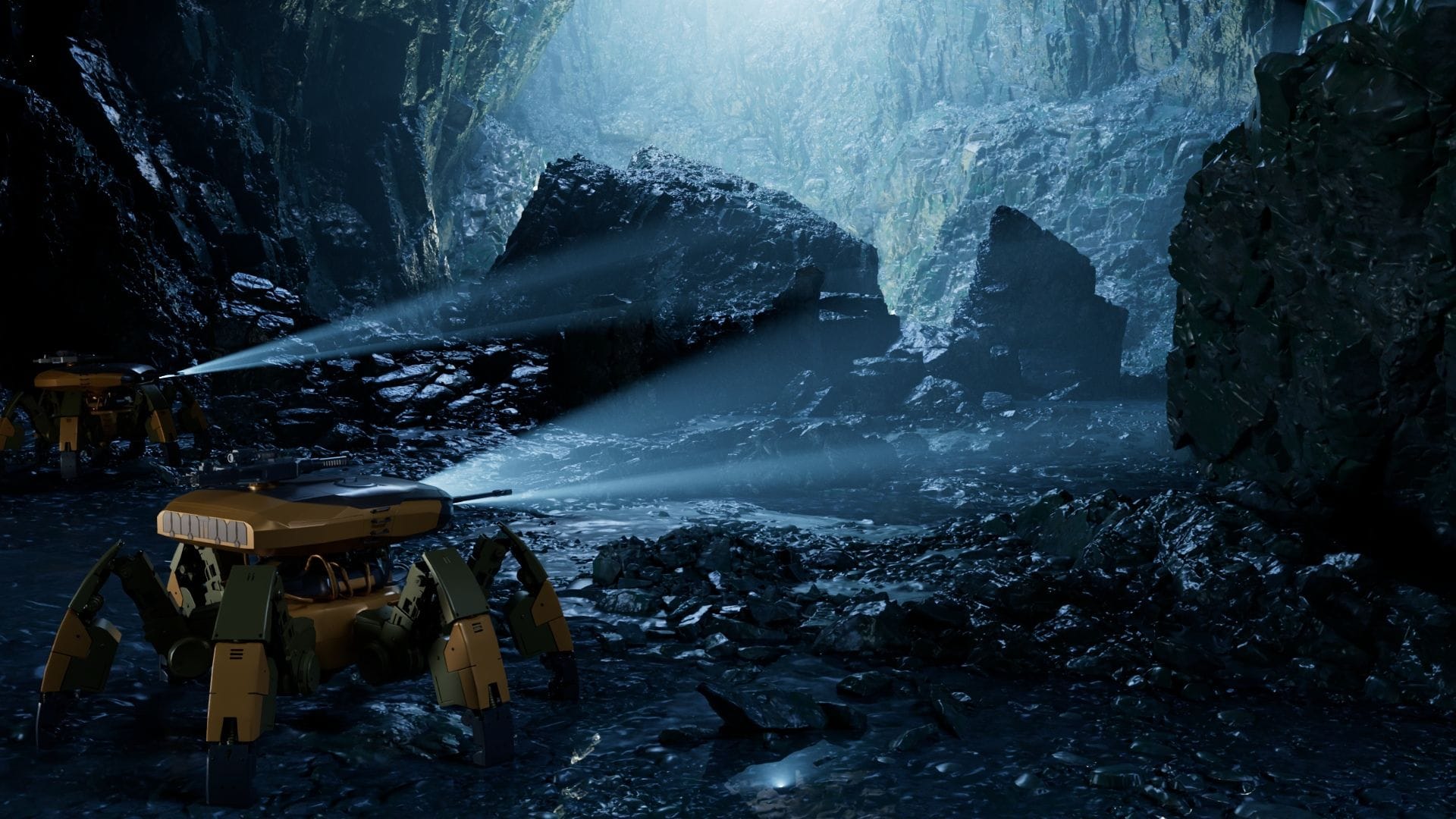
This class covers selecting and analysing reference imagery to inform the design of a photoreal natural environment. You will break down a VFX brief into key production stages: modelling, layout, texturing, and lighting. Then, you will translate the reference into a large-scale cave environment. The focus is on establishing visual targets and defining a cohesive look from the outset.
Class 2: Environment Layout & Composition
In class 2, we focus on constructing the environment to match reference imagery accurately. Topics include asset selection, establishing strong composition, and building clear spatial relationships between objects and the camera. You will learn techniques to minimise visible repetition and prepare the scene for lighting and final rendering.
Class 3: Material Development for Natural Surfaces
This class explores creating materials for large-scale rock environments. You will develop workflows for wet and dry surface treatments and implement triplanar projection techniques to efficiently map textures across complex geometry without visible seams.
Class 4: Lighting & Atmospheric Effects
Next, we cover the setup of lighting and atmospheric effects to match a cinematic reference. You will learn how to control spotlight radius and intensity, adjust volumetric fog density, and balance colour to achieve photographic lighting effects such as god rays and a balanced overall scene mood.
Class 5: AOV Setup for Compositing
In this class, we prepare the scene for compositing by setting up a comprehensive AOV pipeline. This includes cryptomattes, diffuse, specular, indirect lighting, volumetric passes, and light groups. The focus is on creating flexible render outputs that support downstream compositing workflows.
Class 6: Solaris & USD Workflow Overview
This session introduces the USD-based workflow in Houdini Solaris. You will learn to manage complex scenes using proxy and high-resolution geometry, navigate large datasets efficiently, and utilise Karma GPU and CPU rendering. The class also covers viewport performance with the Houdini Vulkan display.
Class 7: Asset Layout & USD Scene Assembly
In this class, you will build and refine an environment layout within Solaris using a proxy/render geometry workflow. Topics include editing USD assets, applying transformations and scaling, and creating scatter systems driven by heightfields projected onto high-resolution terrain.