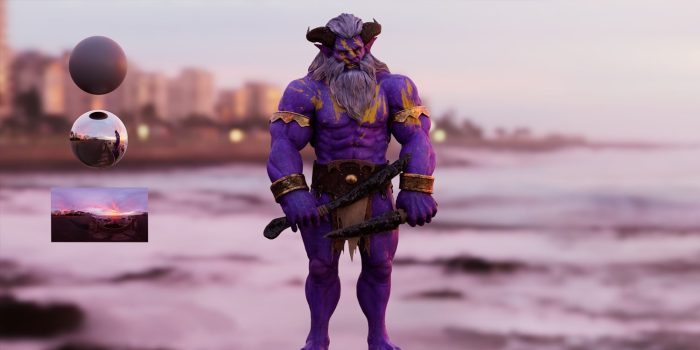
Texturing humanoid creatures requires a careful balance of artistic intent and technical structure. From skin and hair to hard-surface props and accessories, creature assets bring together a wide range of materials that must work cohesively within a production pipeline. In this new fxphd course, Bipedal Creature Texturing, senior texture artist Nastasia Bois walks through her approach to texturing a humanoid creature, sharing practical workflows shaped by real-world studio experience.
The course begins with reference analysis, planning, and material breakdowns, establishing a clear foundation before moving into the texturing work itself. Nastasia demonstrates how to prepare utility maps and organise a clean, scalable Mari project, then steps through the texturing of key creature materials, including skin, hair, horns, claws, eyes, and mouth. Throughout the course, artists work with diffuse, specular, roughness, normal, and subsurface scattering maps before moving on to supporting prop materials such as leather, fur, metal, and rock, and learning how to integrate organic and hard-surface elements into a cohesive asset. Mari is used as the primary texturing tool throughout the course, with Substance Painter used to generate utility maps and base materials where appropriate. Nastasia explores Mari’s node graph in detail, demonstrating how to build flexible, readable networks using masks and layered materials. The course also covers efficient export strategies and presentation techniques, ensuring textures are not only visually strong but also ready for downstream lookdev and handoff in a studio environment.
Bipedal Creature Texturing is taught by Nastasia Bois, a senior texture artist based in London with over 12 years of experience across animation, advertising, and high-end visual effects. Her credits include work for studios such as TeamTO, Milk VFX, and ILM, spanning props, environments, and detailed creature assets. With a specialisation in creature texturing, Nastasia brings a strong understanding of both technical workflows and visual storytelling, offering insights that reflect the realities of production work.
This course is well-suited to artists looking to strengthen their creature-texturing workflows, improve consistency across complex assets, and gain confidence in delivering production-ready textures. Whether you’re refining your Mari skills or looking to better understand how creature textures are structured for lookdev and pipeline integration, Bipedal Creature Texturing provides a clear, practical walkthrough grounded in studio practice.
Artists looking to expand their Mari workflows further may also be interested in Nastasia’s previous fxphd course, Hard Surface and Creature Texturing, where you will texture two production-style assets: a sci-fi robot and an organic dinosaur.