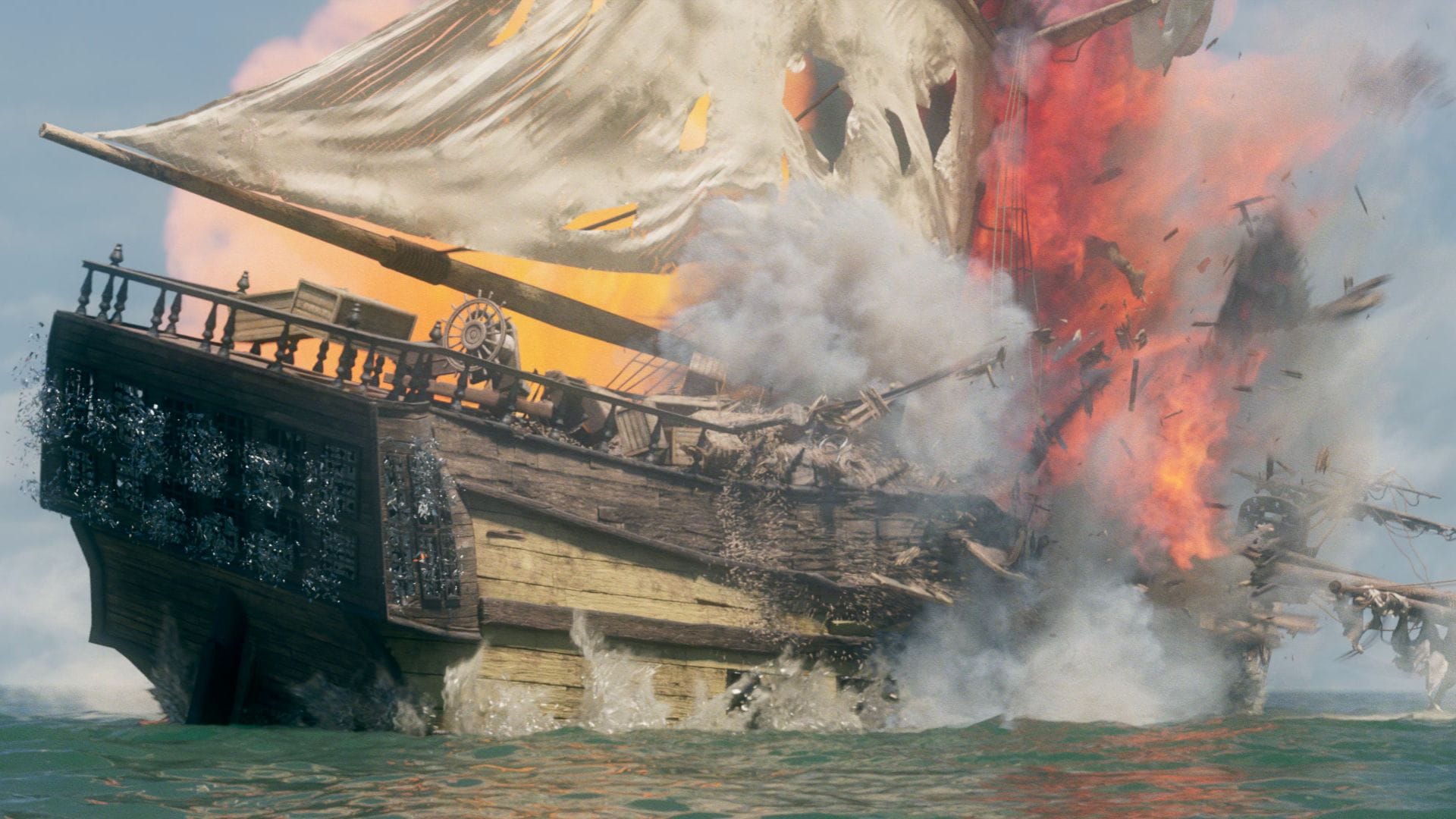
Pirate Ship Destruction Workshop Part 1: FX Simulation
Taught by Ganesh Lakshmigandan
- Duration:
- 8 hours 43 minutes
- Software Version:
- 21
- Launch Date:
- May 2026
- Course Number:
- HOU245
3D
vfx
3D
vfx
* MPM hull destruction
* RBD secondary destruction
* Particle-based splinter simulations
* Large-scale Pyro explosions and smoke
* Vellum rope and cloth simulations
* FLIP ocean interaction and surfacing
* Whitewater and water explosion workflows
The course starts with project planning, reference analysis, fracturing workflows, and simulation sequencing before progressing to core FX setups. Artists will learn techniques for controlling destruction timing, achieving realistic force propagation, layering secondary motion, and integrating multiple simulation systems into a cohesive cinematic result. The curriculum emphasizes practical Houdini workflows using native tools and production-oriented methods suitable for a range of destruction and environmental FX projects.
Ganesh Lakshmigandan brings extensive production experience to this workshop, with credits on major feature films and episodic projects such as Avatar: The Way of Water, House of the Dragon, Avatar: Fire and Ash, Dune: Part One, The Jungle Book, and Dunkirk. His expertise includes large-scale destruction, environmental FX, simulation workflows, and cinematic shot production for some of the industry’s most technically demanding projects.
Class Listing
Class 1: Project Kickoff, Reference Analysis & Asset Preparation
The course begins with an overview of the final pirate ship destruction sequence, including project scope, shot goals, and expected deliverables. Ganesh breaks down reference footage and identifies the key action beats required to structure the destruction sequence effectively.Artists will explore the concept of repeated action cuts and how they are used to time and layer simulation events across complex FX shots. The class also covers planning the hierarchy and interactions of major FX elements before moving on to preparing and fracturing the ship assets for downstream destruction workflows.
Class 2: MPM Hull Destruction
Class 2 focuses on large-scale hull destruction using Houdini’s MPM workflows. Fractured ship geometry will be integrated into the MPM solver to create heavy structural deformation and large-scale breakup effects.Ganesh explores techniques for controlling material behavior, introducing weak points, and generating custom burst velocities to drive destruction patterns that match cinematic reference. The class concludes by deforming pre-fractured geometry using MPM simulation data to create more organic, physically grounded destruction motion.
Class 3: Secondary RBD Destruction & Debris Simulation
Building on the MPM hull destruction, this class introduces secondary rigid body simulations for ship elements, including crates, barrels, belaying assemblies, and window glass.Artists will fracture and simulate these assets using Houdini’s RBD workflows while layering additional particle-based simulations to generate splinters, planks, and fine particulate debris. The focus is on creating believable secondary motion and enhancing the overall complexity and scale of the destruction sequence.
Class 4: Pyro Simulation A: The Main Blast
This class focuses on the primary pyro simulation work for the sequence, including the main explosion and multiple secondary dust shooter effects.Ganesh explores techniques for shaping large-scale cinematic explosions using Houdini’s native Pyro tools, with particular attention given to recreating the brief implosion behavior often seen in large blast events. Artists will work with custom divergence fields and directional controls to shape the explosion timing, scale, and overall visual energy.
Class 5: Pyro Simulation B: Secondary Bursts
Continuing the pyro workflow, this class focuses on layering additional explosion elements throughout the sequence.Artists will create secondary-burst simulations, background-explosion passes, and shockwave-driven effects designed to rupture sections of the upper-deck hull. The class emphasizes layering multiple pyro elements together to build a more dynamic and believable large-scale destruction sequence.
Class 6: Vellum Rope & Cloth Simulation
This class introduces soft body workflows using Vellum to simulate rope systems and cloth elements attached to the ship’s main mast.Ganesh covers setup techniques, constraint behavior, simulation stability, and approaches for integrating soft body motion into a larger destruction environment. The focus is on creating believable secondary motion that reacts naturally to the surrounding destruction and environmental forces.
Class 7: Advanced Mast Setup & Soft Body Workflow Extension
Next, Ganesh expands the Vellum workflows developed in the previous session across the remaining mast and rigging systems.Artists will explore strategies for scaling and adapting existing setups to more complex structures while maintaining simulation consistency across the full ship asset. The class also covers optimization considerations and broader approaches for managing large soft body setups within destruction-heavy FX sequences.
Class 8: Ocean Spectrum Integration, FLIP Simulation & Water Surfacing
This class focuses on building large-scale water interaction systems for the sequence using Houdini’s FLIP workflows.Artists will generate and integrate an ocean spectrum into a SOP-based FLIP simulation, then introduce custom burst velocities and shockwave forces to simulate explosive interaction with the surrounding water surface. The class concludes with techniques for surfacing and refining the FLIP simulation for cinematic rendering.
Class 9: Whitewater, Water Explosions & Secondary Splash FX
The final class focuses on secondary water effects and simulation layering to complete the sequence.Ganesh demonstrates the creation of large-scale whitewater using Houdini’s SOP-based workflows, then moves on to DOP-based water-explosion setups driven by custom drag forces and directional motion controls. The session concludes with additional splash simulations triggered by falling debris elements to further enhance realism and environmental interaction throughout the shot.