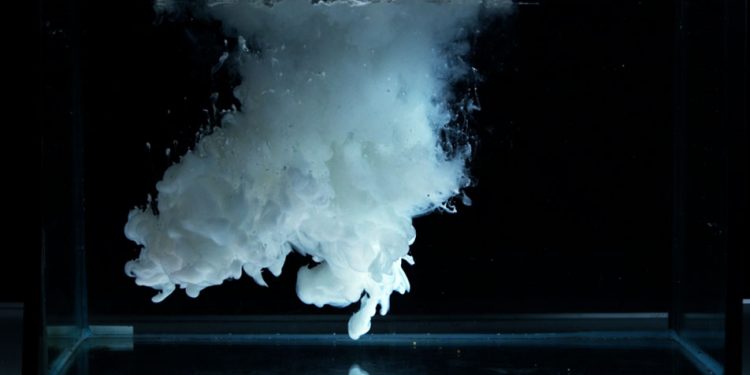
So I have a confession. One of the best parts of our job here at fxphd is to do stuff that we have just wanted to do for years but never had a client or a budget or a project that allowed it. One such thing is cloud tanks. I just like cloud tanks. So this week we started our first tests with them. Some — not all — but some of this work will be in next term’s fxphd courses and some will appear in Jan 09.
Now I need your help dear fxreaders. We have to work out how to do layers in the water, an old school technique of having different levels of density to the water by having salt layers. The theory is something to do with having different mixes of salt water in a still tank and then this acts as a buffer for the expanding cloud tank primary - in our case liquid latex. I know out there some of your will know of a DVD extra or an article or book that explains this, for me googling salt water cloud tank inversion did not get me much - I did find this on the Raider of the Lost Ark site:
“They created an inversion layer in the tank using different temperatures and densities of solutions, for example a layer of salt water on the bottom of the tank with a layer of fresh water above it. Various pigments and dyes could float in the plane where the two layers meet thereby generating different types of cloud effects. They used what they called an ‘atomic arm’ (a remote-controlled hand, such as the ones used for moving isotopes in nuclear laboratories) to squirt pigment into the tank at the appropriate level. It is designed so that someone can control the insertion of the pigment from back near the camera, so he can see pretty much what the camera sees as he makes a shot. ”
My problem is how do you create such a layered effect without it just all mixing?? So if please hit your old copies of cinefex and email or post here any techniques on how to do this… we have just started our journey but this is uncharted old school techniques. I have no experience in this, I am having to re-learn some nearly lost skills from our visual effects playbook.
September 25th, 2008 at 8:35 pm
WOW! i requested this back in Nov30th 2007 I didn’t think anyone noticed!
September 25th, 2008 at 9:34 pm
Bottom of pg 112 http://books.google.com/books?id=U3hH9z24c80C&pg=PA113&lpg=PA113&dq=salt+water+tank+fresh+water+inversion+layer&source=web&ots=hr3GzOQ8ig&sig=V6GHsuZCE27pan-iPs2acsWxWAc&hl=en&sa=X&oi=book_result&resnum=9&ct=result#PPA112,M1
“To create the effect of clouds billowing towards the camera, a large glass tank is half filled with a heavy saline solution. A layer of plastic sheeting is then floated on top of the saline liquid and fresh water is gently poured over it. After the water settles the plastic is carefully removed causing as little disturbance as possible. Salt and fresh water have different densities, and this causes an invisible barrier called an inversion layer to form where the two liquids meet. Various liquids can be employed to create the clouds themselves………….etc…………..yada yada yada…. read it yourself.”
These might also help… not film tank related but….http://www.sciencebuddies.com/science-fair-projects/project_ideas/OceanSci_p002.shtml?from=Home
cheers
September 26th, 2008 at 5:26 am
Hi Mike,
I ordered this book Creating Special Effects for tv and video. I haven’t red it yet. I have look for it inside what you need but I haven’t found it.
You may want to have a look at its contents in Amazon. If you find something about what you’re looking for please let me know it
and I read that specific chapters for you.
The content is http://www.amazon.com/gp/reader/0240514742/ref=sib_dp_pop_toc?ie=UTF8&p=S006#reader-link
pAco
September 26th, 2008 at 7:42 am
Some of the original work done by Douglas Trumbull (vfx - Close Encounters) might be of use. Check out “The Cloudspotter’s Guide” by Gavin Pretor-Pinney
Cloud Spotters: http://books.google.com/books?id=gbDYPEiB0T0C&pg=PA101&lpg=PA101&dq=%22cloud+tank%22+pdf+steps&source=web&ots=-IOyI0Ssrf&sig=3hCwzO3oCCp6LL5yv1m7pmxXs3Y&hl=en&sa=X&oi=book_result&resnum=10&ct=result#PPP1,M1
September 26th, 2008 at 1:01 pm
It has to do with the density of the salt water. They will eventually mix via diffusion. But fresh water rides over salt water due to difference in density. I would experiment with a glass and see how long you will have to wait for it to settle, I’d suspect 5 minutes or so… It trial and error in the end.
I am so envious of you for the fun you guys get to have!
September 26th, 2008 at 3:11 pm
There’s a page on cloud tanks on p140 of Special Effects The History and Technique by Richard Rickitt but it pretty much says the same Carbon Girl.
September 26th, 2008 at 3:19 pm
There is a video on YouTube showing how to do this with condensed milk.
http://www.youtube.com/watch?v=DwtobAye-18
~Victoria~
September 26th, 2008 at 3:27 pm
There’s a small section on the Star Trek II extras, where Ken Ralston explains how they did the Nebula effects usiing a cloud tank, it’s not very long but they do show some footage of filming but pretty much says the same as the others.
September 26th, 2008 at 5:24 pm
The plastic sheeting sounds like over kill. First off head to any good bar and ask for a black and tan. Talk to the bartender about how he spooned it together (layered it)
(maybe the sheet is best no clue)
I would suggest that different layers of water should be mixed in buckets with something like an aquarium type of salt mix. This will give you the highest salinity and clearest water which I assume will help capture what you are after. Then combine these as you are about to do a shot. You may also want to take note of temperatures of each layer. Depending on both the temperature and salinity of each layer you should be able to get a thicker/stronger layering effect that will last a bit longer.
As a Diver I’ve encountered the “thermocline” often and this is pretty much the effect and how it works from my dive knowledge. Low temperature and high salinity will give the highest density of water. Higher temperatures and lower salinity is less dense. then cold fresh/tap water will be more dense then hot water.
So maybe you could try:
35-40% salinity at room temp. or chilled a bit. (most dense)
20-25% salinity slightly heated or room temp
Cold Freshwater
Heated Freshwater (least dense)
** be sure to mix the salinity when the water is all at the same temperature. As the temperature increases water can absorb more dissolved salts and it may mess you up.
Check also under the following terms as related to diving:
Thermocline (layering of dense waters based on temperature)
Halocline (layering based on salinity; ie salt and freshwater layering)
Density Stratification (general term for these natural events)
Cheers,
Chris.
September 26th, 2008 at 6:35 pm
kaw256 The book I was quoting from (and posted the link to) WAS Richard Rickitt’s book. Great that it is so popular!
September 27th, 2008 at 1:45 am
My bad, should have clicked on the link to find out. Great book though.
September 27th, 2008 at 2:04 am
http://www.wonderhowto.com
Hi Mike,
These Guys, btw RED users, have had a long presentation at DMA.L.A. about fluids, as well high-speed Filming etc. They had tested tons of chemicals to change the behavior of water/fluids. For these and other effects.
I hope that helps
Best
sassi
September 27th, 2008 at 4:46 pm
Brilliant feedback guys - we knew we could count on you! This is going to be so much fun. My fave so far is the idea of having a rig at the bottom of the tank - film from above from Memphis Belle. At the bottom of the tank is a real aerial photograph - and as the camera moves over - small jets push up the cloud material - net effect a bombing raid with explosions coming up. I so have to try that.
September 27th, 2008 at 6:26 pm
Hi Mike,
Have a look please…it may is what you were looking for
http://es.youtube.com/watch?v=DwtobAye-18
http://es.youtube.com/watch?v=hxgVKWe5Vm0
Hope that helps,
pAco
September 29th, 2008 at 2:11 pm
This is also covered in a few of the old 80’s Cinefex magazines when they were developing the technique on Close Encounters, I believe. I have them at home & will post more detail later– I was rereading a few weeks ago, actually. Generally the saline/plastic sheet/fresh water and then carefully remove was the recipe. Lots of good info on materials/inks, how they made different nozzles etc– the had needles on mocon arms that they would program through for those moving cloudheads in CE3K. Good old Cinefex–
September 29th, 2008 at 2:24 pm
Good for you!This looks like fun. I pitched a shoot for this but was told it makes for long shoot days because you have to clean the tank between shots.
Ended up using caustics effect out of Nuke. The Star Trek Next Gen team did some nice stuff back in the 80’s we ended up with about 15 minutes of 1″ tape if it thats was used all the time on the show for funky textures and screens. The same team did Cheech and Chong main titles.
have fun,
Jeff O.
September 29th, 2008 at 7:08 pm
If you do head to the bar per Chris’ suggestion for research, definitely ask them about how they make a Pousse Cafe - its a mulitlayered drink that is usually 6-8 separate, visually distinct layers.
September 30th, 2008 at 5:53 pm
Re the cocktails - I make killer cocktails but the problem is a bit different due to the vastly greater amounts of water / liquid. and the glass is a much thinner taller thing - or even a V shape cocktail glass the tank is buckets and buckets of water… but thanks for the suggestion…
All the suggestions
Mike
October 3rd, 2008 at 2:53 am
I’d use a drinking straw to add each layter of liquid, and start with the one with the highest density and work upwards. Looking forward to the class!
October 16th, 2008 at 1:32 am
I can’t believe you didn’t post my earlier comment on getting input from Scott Squires!
Bums.
October 16th, 2008 at 9:14 am
Hey Joe — that comment didn’t come through. We post comment we get and only trash spam posts (of which there are quite a few).
We’ve been in contact with him and he’s been a fantastic help…so even though we didn’t see your comment, thanks for the suggestion.